Text from this review not to be used without authorization.
Please contact:

Roy Ward Baker directs Peter Cushing and Herbert Lom in a classic ghost story tale from Amicus. ABUK R2 boxset release
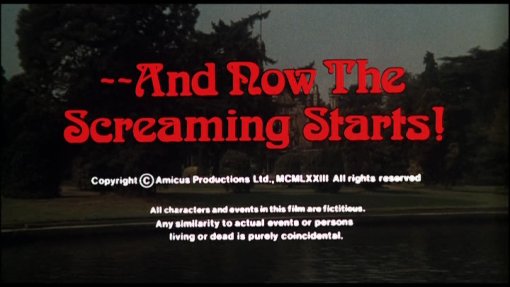
In the 1970s, gothic and period horror was in decline and Hammer were experimenting with updating their classic stories (Dracula A.D. 1972 (1972) went some way to proving the folly of this. Amicus had spent most of their time shooting contemporary stories in their anthology stories and had had little success with their period horror films such as I, Monster (1971). However, co-owner Milton Subotsky saw the potential for shooting a classic ghost story to fill the gap that Hammer had left in the market.
In 18th Century England, Catherine (Stephanie Beachham) is arriving at her new home - she is pledged to be married to young Charles Fengriffen (Ian Oglivy) a suitably wealthy landowner. After the wedding she is waiting expectantly in the bedroom when she is brutally attacked and raped by the ghost of a one-armed man. The family doctor, Dr. Whittle (Patrick Magee) suggests that it was simply a hallucination brought on by a case of nerves and Catherine believes him, but the servants seem unsure and very afraid and when several of them are killed while trying to either take Catherine away from the house, or tell her something, she becomes highly suspicious of a man who lives on the estate called Silas who strongly resembles the spirit she saw. As the problems worsen, Dr. Whittle calls in Dr. Pope (Peter Cushing) from London, who eventually manages to get Fengriffen to admit that there was a curse placed on the family, two generations ago...
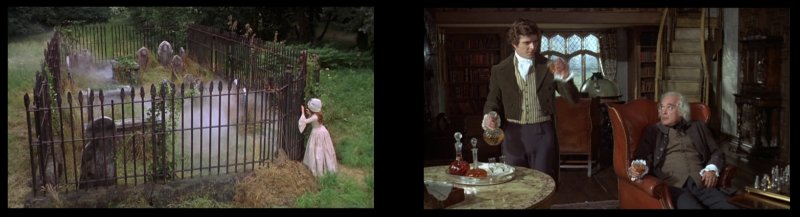
Based on the novel Fengriffen by American writer David Case, the story and screenplay hark back to the classic Victorian-era ghost stories; with large country mansions, mysterious secrets and restless spirits - even the opening narration brings to mind the framing stories of most gothic horror tales. Despite the familiar tones, the storyline manages to stay out of mere cliché territory.
It all starts off very well, building up the horror and mystery and keeping the audience (along with Catherine) in the dark as to the reasons behind everything - there is some wonderful subtlety behind the hauntings that makes them genuinely scary, akin to the acclaimed work in The Haunting (1963). Unfortunately the film does soon reject the subtle tones with four deaths in quick succession that almost become parody-like by the end - one or two deaths would have been fine, especially considering that only one of those involved was actually going to take Catherine away from the house, the others would have just told her the story behind the legend (which she later hears about anyway without harm). Fortunately after this sequence the films picks up again and builds to a good and quite unexpected climax. The dialogue throughout the film is fitting for the period, although not the beautiful lyricism of the AIP Poe films, it avoids anachronism well. The pacing is quite sedate, as per the classic ghost stories by which it is inspired, but it could perhaps have used a little more run-time to build up Catherine's character between the scares.
Roy Ward Baker's direction however is completely flawless, combining with the script to make the film tangibly scary in several places and bringing a strong atmosphere to the production. The use of long tracking shots, particularly combined with some special effects shots is very effective and really helps to ratchet up the tension, clearly proving the ineffectiveness of the modern MTV-style editing. The special effects themselves are a product of their time and don't look great, but Baker keeps them in the background and subtly lit so that the flaws are less noticeable. The sets and location shots (using Hammer's old studio Oakley Court for exteriors) are beautifully fitting, none more so that the fog enshrouded graveyard that perfectly encapsulates the Victorian ghost story ambiance. Composer Douglas Gamley provided most of the later era Amicus soundtracks and does the duty again here with what is certainly his best work, really helping to boost the atmosphere even further.
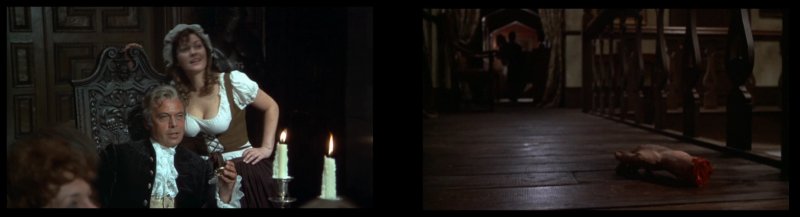
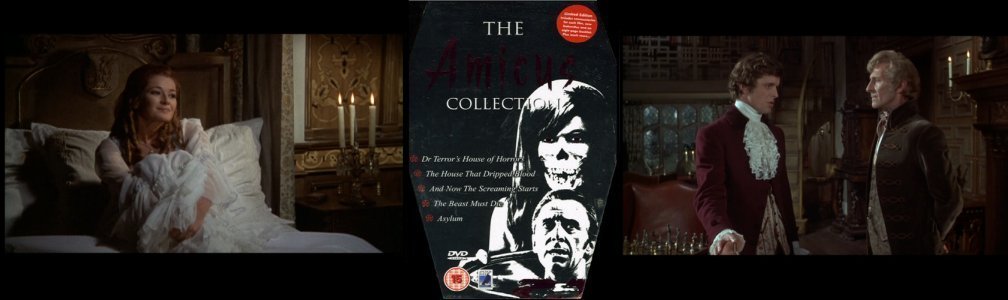
Top billed are three cult movie stars, Herbert Lom, Patrick Magee and as always, Peter Cushing (who appeared in all bar one of Amicus' horror titles). Dr. Pope is a very Holmsian character and Cushing is the perfect choice to play it, allowing his performance to be rather more abrupt than his usual, almost fatherly roles (cf. Van Helsing in Dracula A.D. 1972 (1972)). Herbert Lom only gets a brief role (although his visage, in the form of a painting, is a centrepoint of the film), and he certainly seems to be enjoying himself playing the debauched Henry Fengriffen. Future Saint Ian Ogilvy gives a strong performance as Charles, but the best performance of the film is certainly given by Stephanie Beacham as the tortured Catherine and her descent into madness. She manages to elevate the role above the mere "scream queen" performance it could have been, with some wonderfully understated acting throughout, the best example in the sequence at the start as she awaits her new husband in their marital bed, where she manages to convey nervousness and excitement without a line of dialogue.
Boasting some very strong acting, solid production, beautiful music and an inspired directorial turn from Roy Ward Baker, And Now the Screaming Starts is a near-perfect ghost story, with only some elements of the script letting it down. Still, it remains the most effectively scary horror film that Amicus ever released and competes with the best that Hammer and their European or American rivals had to offer. Highly recommended to Amicus and Brit-horror fans and generally recommended to all horror fans.
| Anyone famous in it? |
Peter Cushing - one of the true icons of horror movies, beginning in 1957 with Hammer's Curse of Frankenstein
Herbert Lom - versatile cult movie star, from Phantom of the Opera (1962) to Jess Franco's 99 Women (1969) |
| Directed by anyone interesting? | Roy Ward Baker - the British director best known for the impressive Titanic film A Night to Remember (1958) who also shot three Amicus pictures, Asylum (1972) and Vault of Horror (1973) as well as this film. |
| Any gore or violence ? | Nothing vivid. |
| Any sex or nudity? | A couple of covered sex scenes and some glimpsed nudity. |
| Is it scary? | Several scenes that are atmospherically scary and a few jump shocks. |
| Who is it for? | One that all Amicus and classic horror fans must see, and generally all horror fans should enjoy this. |
| Visuals | Original Aspect Ratio - 1.78:1 anamorphic widescreen. Colour. The print is generally good, good colours - some light damage and grain. |
| Audio | English original mono sounds good, plus rather unnecessary 5.1 and DTS remixes. |
| Subtitles | None. |
| Extras | The disc includes:
|
| Availability | Only available in the Anchor Bay UK Amicus Collection boxset. |
| Region | Region 2 (UK, Europe) - PAL |
| Other regions? | Available on DVD from Dark Sky in the US, including both of the audio commentaries, trailer and TV spots. |
| Cuts? | Fully uncut. The print used is English langauge. |