Text from this review not to be used without authorization.
Please contact:

Laura Gemser stars in Joe D'Amato first entry into the Black Emanuelle series. Severin Films USA R0 DVD.
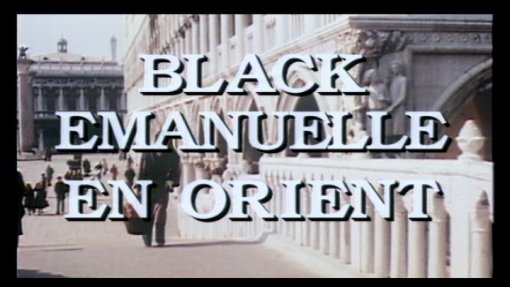
Photo-journalist Emanuelle (Laura Gemser) is travelling to Bangkok with her friend Roberto, she is hoping to take photographs of the King of Thailand for an American magazine. She meets with Prince Sanit who introduces her to the joys of an Oriental massage and later meets up with an American couple and over an opium pipe they discover the joys of liberation. After seeing off her friends, Emanuelle finds herself in trouble when the Prince is evicted from the country for plotting to overthrow the king and Emanuelle is robbed and raped by some of the palace guards. Eventually managing to flee the country, she heads for Casablanca to meet up with Roberto again and finds herself unexpectedly becoming the role model for the American ambassador's young daughter.
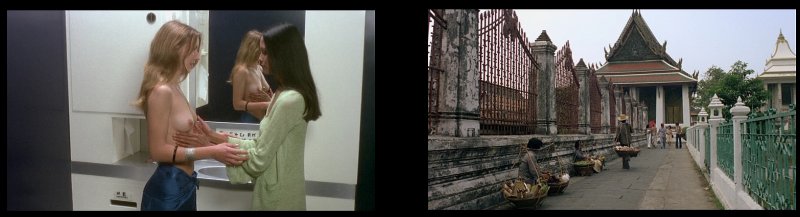
The global sucess of Just Jaekin's Emmanuelle (1974) film quickly led to a slew of sequels and knock-offs, one of the most popular of which was Black Emanuelle (1975) (just one M to avoid copyright issues) which starred Indonesian born Laura Gemser as a photo-journalist. While the original Emmanuelle series had focused on the extra-marital affairs of a lady of leisure, which although liberating for her, were completely at the whim of her male 'teacher', the Black Emanuelle film made its lead a photo-journalist and a strong independent figure who chooses her own lifestyle.
This journalist storyline is used throughout the Black Emanuelle series and it provides plenty of opportunities for the character to travel around the world visiting a variety of exotic locales, with no particular hurry to pass through any of them. Emanuelle in Bangkok uses this opportunity to perfection, allowing its lead to travel first to Thailand and later to Morrocco, with a real travelogue feel (at times bordering on becoming a Mondo film, most notably in the otherwise unnecessary shots of a fight between a snake and a mongoose). Bangkok was the location of the original Emmanuelle film, and it is clear that the writers are trying to outdo their illustrious predecessor, especially in the night club stakes - the infamous "cigarette" scene from the first film is surprassed here by a scenes with a stripper who can do amazing things with ping-pong balls.

The storyline itself flows well, building enough interest in the Emanuelle character to keep things interesting between the sex scenes, with some good characterisation for the rest of the cast as well, something that many erotic films fail to do. Dialogue is often the downfall of a sex focused film, but unlike Emmanuelle (1974) we are not treated to some daft philosophy, nor the foul-mouthed "dirty talk" of most modern erotica, but instead some surprisingly well written and plausible conversations that really help to build the characters. As expected there are plenty of sex scenes, but the writers manage to keep the balance on the storyline side, so Emanuelle in Bangkok becomes a narrative film with sex rather than a sex film with some storyline and as a result the pacing is strong and the plot is not just padding.
Most of the sex takes the form of Emanuelle liberating some previously stuffy men and women, but most interesting is the relationship between Emanuelle and the American ambassador's daughter which comes off as surprisingly tender and could well be something out of a more serious film, building to a surprisingly emotional conclusion. The only sequence that seems to be really unnecessary is the gang-rape of Emanuelle by some of the King's guards, which is then followed by the lead guard walking her carefully back to her car and telling her to take care - the writers do not really make enough of this gratuitous sequence, which could have been followed by Emanuelle becoming discouraged and afraid to trust men, but instead, like the Prince who promises Emanuelle the ultimate orgasm, it seems to be completely forgotten once she leaves Thailand.
Director Joe D'Amato is best known for his very sleazy films (notably, the infamous Antropophagus (1980)) but he shows a lot more subtle talent here. The majority of the film is shot well, with some very nice exterior locations in Morrocco and Thailand, and the sex scenes are very nicely filmed - managing to remain erotic without becoming mere pornography although they do have a tendancy to edit away quite suddenly which can make it appear as though they are cut. Obviously blessed with a good budget the sets all look very good, while the soundtrack by Nico Fidenco (used in all of the Black Emanuelle films) has an incredibly cheesy opening theme, but generally works well throughout the film.
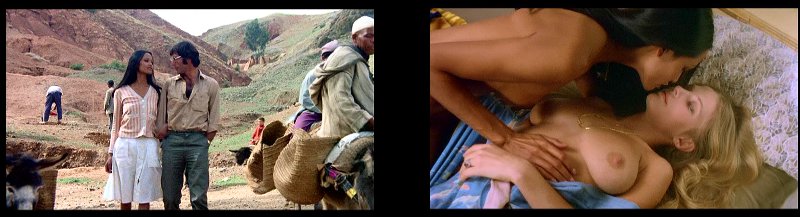
Laura Gemser returns for the first of the Black Emanuelle sequels in the title role. Incredibly slim, she looks very confident in the nude scenes but is equally good in the rest of the film, she certainly has the presence to be the independant woman that she portrays. Euro-cult actors Ivan Rassimov (Terrore Nello Spazio (1965)), Giacomo Rossi-Stuart (Operazione paura (1966)) and Venantino Venantini (Cannibal Ferox (1981)) provide good supporting roles, while Gemser's real life husband Gabriele Tinti (who starred alongside her in all the Black Emanuelle movies) plays Roberto very well, sucessfully making his character quite unpleasant in the later scenes. The two main female supporting roles are played by the incredibly attractive Ely Galleani (who would go on to appear in Emanuelle and the White Slave Trade (1977)) and beautiful Debra Berger (daughter of William Berger and best known for starring in Inglorious Bastards (1978)).
Emaneulle in Bangkok will probably come as a surprise to some and a disappointment to others. Not half as sleazy as one might expect from a Joe D'Amato credit (and probably the most gentle entry of the main Black Emanuelle films), it is instead a very well written and directed erotic film, that manages to convey a strong narrative and still be very sexy, particularly thanks to a stunningly attractive female cast. Although let down slightly by a gratuitous animal fight and a seemingly tacked on rape scene, the film is very enjoyable and comes recommended. A good place to start exploring the Euro-sexploitation cinema of the 1970s.
| Anyone famous in it? | Laura Gemser - the very popular erotic film star who also appeared in Caligula 2 - The Untold Story (1982) |
| Directed by anyone interesting? | Joe D'Amato - the Italian born director behind such controversial cinema as Antropophagus (1980), Buio Omega (1979) and Le notti erotiche dei morti viventi (1980) |
| Any gore or violence? | A short, real sequence of animals fighting. |
| Any sex or nudity? | Extensive female nudity. No male nudity or anything hardcore. |
| Who is it for? | A must see for fans of the other Black Emanuelle films and fans of Laura Gemser. Recommended to fans of Euro-cult erotica from the era. |
| Black Emanuelle (1975) | Bitto Albertini's first film - a rather loosely plotted affair that focuses mainly on a series of erotic sex scenes. |
| Black Emanuelle series | Joe D'Amato's five film series of increasingly sleazy adventures for Laura Gemser's Emanuelle. |
| Visuals | Original Aspect Ratio - 1.85:1 anamorphic widescreen. Colour The print quality is good, with minimal print damage - there are a a pair of tramlines that appear on screen for several seconds but otherwise the print is flawless with only light grain, good colours and plenty of detail. Note: The opening and closing credit scenes are noticably lower quality, very soft like from a video source. |
| Audio | English and Italian audio. Both sound fine, and the English dub is very well done. |
| Subtitles | English (optional) - these translate the Italian track which is noticably different to the English dub. |
| Extras | The disc includes:
|
| Region | Region 0 (ALL) - NTSC |
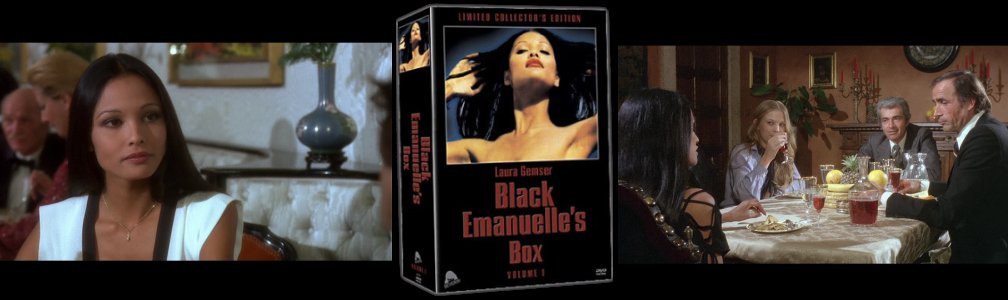
| Availability | Available on its own or as part of the limited edition Black Emanuelle Box. |
| Other regions? | Released in the UK by Optimum releasing with over 4 minutes of cuts imposed by the BBFC (including the animal fighting sequence and the rape scene). |
| Cuts? | Believed to be fully uncut. The print used has French language credits.
|